
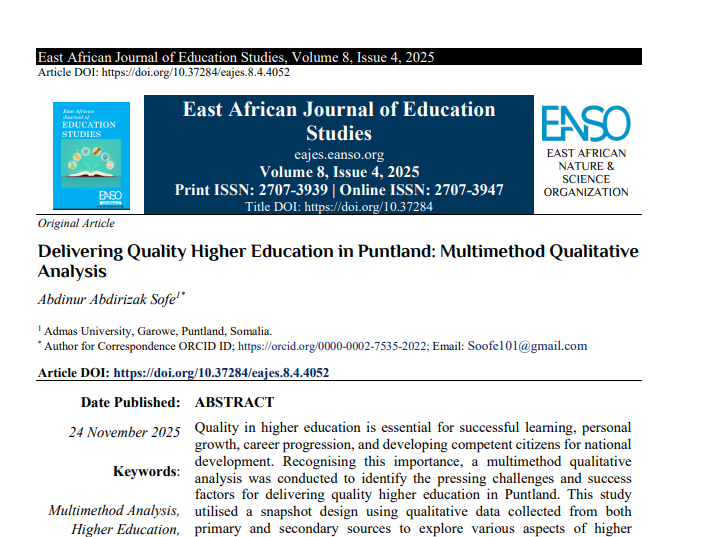
QAHE Best Practices Guideline Cited in Peer‑Reviewed East African Journal of Education Studies
The International Association for Quality Assurance in Pre‑Tertiary & Higher Education (QAHE) is pleased to announce that its publication, International Association for Quality Assurance in Pre‑Tertiary & Higher Education. (2023). Guideline: Best Practices for Quality Assurance in Education and Training Institutions, has been formally cited in a peer‑reviewed academic article published in the East African Journal of Education Studies (EAJES).
The citation appears in the 2025 Volume 8, Issue 4 article titled “Delivering Quality Higher Education in Puntland: Multimethod Qualitative Analysis” authored by Abdinur Abdirizak Sof. The article is available through the journal’s platform at: https://journals.eanso.org/index.php/eajes/article/download/4052/4542/ (journals.eanso.org in Bing) and is associated with the Title DOI: https://doi.org/10.37284
QAHE’s guideline—accessible at: **https://www.qahe.org.uk/wp-content/uploads/2023/12/Best-Practices-for-Quality-Assurance-in-Education-and-Training-Institutions.pdf**— (qahe.org.uk in Bing) provides a comprehensive framework for strengthening institutional governance, academic standards, assessment integrity, learner support, and continuous improvement. Its inclusion in this scholarly study demonstrates the practical relevance and global applicability of QAHE’s quality assurance recommendations.
The cited EAJES article examines the delivery of higher education in Puntland using a multimethod qualitative approach, highlighting systemic challenges and opportunities for improvement. By referencing QAHE’s best practices, the author underscores the importance of internationally informed quality assurance frameworks in enhancing educational effectiveness across diverse regional contexts.
This citation reflects QAHE’s growing influence within academic research communities and reinforces its role as a global leader in promoting excellence, transparency, and accountability in education and training. QAHE remains committed to supporting institutions worldwide through robust standards, practical guidelines, and evidence‑based quality assurance tools.